DMF vs CEP: Understanding Key Pharmaceutical Regulatory Documents
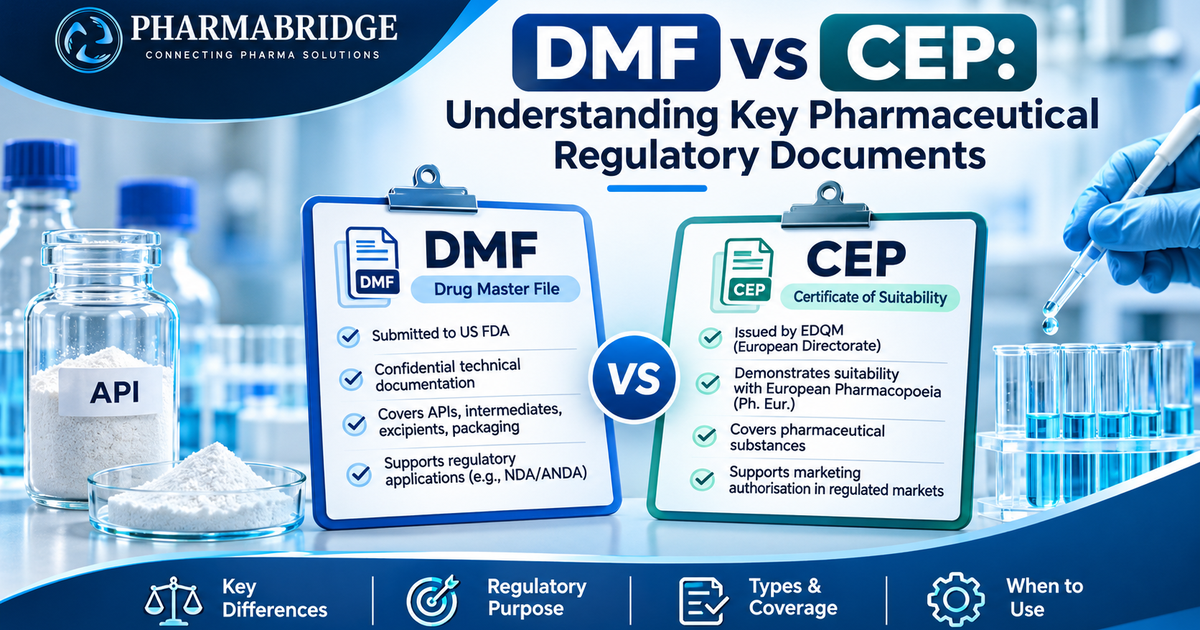
"Explore the key differences between DMF and CEP, their regulatory requirements, importance in pharmaceutical manufacturing, and how these documents support API sourcing, quality assurance, and global pharmaceutical compliance with insights from PharmaBridge."
By PharmaBridge | Pharmaceutical Technical Publications & Regulatory Insights
In the pharmaceutical industry, regulatory documentation plays an essential role in maintaining product quality, safety, and compliance. Whether you are an API manufacturer, pharmaceutical importer, formulation company, or pharmaceutical sourcing professional, understanding regulatory requirements is important for successful business operations.
Two important regulatory documents frequently encountered in pharmaceutical manufacturing and sourcing are the Drug Master File (DMF) and the Certificate of Suitability (CEP).
Both documents support pharmaceutical regulatory processes, but they serve different purposes and follow different regulatory frameworks.
Understanding the difference between DMF and CEP can help pharmaceutical companies make better sourcing decisions, evaluate manufacturers, and prepare appropriate regulatory documentation for international markets.
In this guide, PharmaBridge explains DMF and CEP, their importance, regulatory requirements, key differences, and how pharmaceutical businesses can use these documents effectively.
1. What Is a Drug Master File (DMF)?
A Drug Master File (DMF) is a confidential regulatory submission containing detailed information about the manufacturing process, facilities, materials, packaging, and quality controls associated with pharmaceutical products.
In the United States, DMFs are submitted to the US Food and Drug Administration (FDA).
A DMF allows manufacturers to share confidential technical information directly with regulatory authorities without revealing proprietary manufacturing details to their customers.
For example, an Active Pharmaceutical Ingredient (API) manufacturer may submit a DMF containing information about its manufacturing process, impurity profile, analytical methods, and quality specifications. A pharmaceutical company can then reference that DMF in its regulatory application with the manufacturer's authorization.
Types of Drug Master Files
The US FDA currently recognizes four active types of DMFs:
Type II – Drug Substances and Drug Products
Type II DMFs contain information about:
Active Pharmaceutical Ingredients (APIs).
Drug substance intermediates.
Materials used in their preparation.
Drug products.
Type III – Packaging Materials
Type III DMFs contain information about pharmaceutical packaging materials, including their composition, manufacturing processes, and quality controls.
Type IV – Excipients and Other Materials
Type IV DMFs cover pharmaceutical excipients, colour additives, flavours, essences, and materials used in their preparation.
Type V – FDA-Accepted Reference Information
Type V DMFs contain other FDA-accepted reference information that does not fall under the other DMF categories.
Note: The FDA discontinued Type I DMFs in 2000.
Why Is a DMF Important in the Pharmaceutical Industry?
DMFs provide several benefits to pharmaceutical manufacturers and regulatory applicants.
Confidentiality: Protects proprietary manufacturing information and technical processes.
Regulatory Support: Provides technical information to support relevant regulatory submissions, including NDA and ANDA applications.
Manufacturing Transparency: Documents manufacturing processes, quality specifications, and control procedures.
Supplier Collaboration: Allows manufacturers to share confidential information with regulatory authorities while protecting trade secrets.
Regulatory Documentation: Supports the assessment of pharmaceutical ingredients and manufacturing operations.
An important point to understand is that an FDA DMF is not independently approved or disapproved. The FDA reviews its contents in connection with a regulatory application that references it.
2. What Is a Certificate of Suitability (CEP)?
A Certificate of Suitability (CEP) is a regulatory document issued by the European Directorate for the Quality of Medicines & HealthCare (EDQM).
It demonstrates that the quality of a pharmaceutical substance can be suitably controlled by the relevant European Pharmacopoeia (Ph. Eur.) monograph, together with any additional controls considered necessary.
CEP certification is particularly important for pharmaceutical manufacturers supplying ingredients to European markets and other jurisdictions that recognize this certification procedure.
The certification process involves an assessment of technical documentation covering manufacturing processes, quality controls, impurity profiles, analytical methods, and relevant specifications.
What Information Does a CEP Cover?
A CEP provides important information about the quality and suitability of pharmaceutical substances.
It may cover:
Manufacturing process information.
Pharmaceutical substance specifications.
Impurity profiles and control strategies.
Analytical testing methods.
Compliance with relevant European Pharmacopoeia requirements.
Additional quality controls required for the substance.
Why Is CEP Important in Pharmaceutical Manufacturing?
CEP certification provides several advantages for pharmaceutical businesses.
Demonstrates Pharmacopoeial Suitability
It demonstrates that the pharmaceutical substance can be suitably controlled according to the relevant European Pharmacopoeia monograph.
Supports Regulatory Applications
Manufacturers can use CEP documentation to support relevant marketing authorisation applications.
Supports International Market Access
CEP certification is recognized by European Pharmacopoeia member states and several other countries and regulatory organizations.
Provides Standardized Quality Assessment
The certification procedure provides an established framework for assessing the quality documentation of pharmaceutical substances.
Improves Regulatory Transparency
It helps pharmaceutical manufacturers and regulatory authorities evaluate relevant quality information through a recognized certification process.
3. Understanding the Key Differences Between DMF and CEP
Although DMF and CEP are both important pharmaceutical regulatory documents, their purposes, issuing authorities, and applications are different.
Difference in Regulatory Purpose
A Drug Master File primarily provides confidential manufacturing and technical information to support regulatory applications.
A Certificate of Suitability demonstrates that a pharmaceutical substance can be suitably controlled according to relevant European Pharmacopoeia requirements.
In simple terms, DMF focuses on providing detailed technical information, whereas CEP focuses on demonstrating pharmacopoeial suitability.
Difference in Issuing Authority
A DMF is submitted by its holder to a regulatory authority, such as the US FDA. It is not a certificate issued by the FDA.
A CEP is issued by EDQM following its technical assessment and certification procedure.
Difference in Confidentiality
DMFs contain confidential and proprietary manufacturing information. Their contents are generally not publicly available in full.
A CEP is a public certificate, although the technical documentation submitted for its assessment includes confidential information.
Difference in Regulatory Application
DMFs support relevant regulatory applications, such as US drug applications that reference the file.
CEPs support pharmaceutical substance quality documentation and relevant marketing authorisation applications in jurisdictions that accept them.
Difference in Regulatory Coverage
DMF coverage depends on the type of file and the regulatory authority receiving it. It may include drug substances, intermediates, packaging materials, excipients, and other accepted reference information.
CEP certification applies to eligible pharmaceutical substances assessed under the relevant European Pharmacopoeia certification procedure.
Difference in Market Requirements
DMF requirements depend on the regulatory authority and target market. FDA DMFs are particularly relevant when supporting US regulatory submissions.
CEPs are particularly relevant for European regulatory procedures and other jurisdictions that recognize CEP documentation.
4. DMF vs CEP: Which One Does Your Pharmaceutical Business Need?
Choosing between DMF and CEP depends on your target market, pharmaceutical product, regulatory strategy, and customer requirements.
When Do You Need a DMF?
A DMF may be relevant when:
You manufacture APIs for the US pharmaceutical market.
Your customer needs to reference confidential manufacturing information in an FDA application.
You supply pharmaceutical intermediates or excipients requiring supporting regulatory documentation.
Your manufacturing information needs to remain confidential while supporting a customer's regulatory submission.
For example, an Indian API manufacturer supplying an ingredient to a US generic drug company may maintain an FDA Type II DMF.
The pharmaceutical customer can obtain a Letter of Authorization (LOA), allowing the FDA to reference the relevant DMF information in its regulatory application.
When Do You Need a CEP?
A CEP may be relevant when:
You manufacture pharmaceutical substances intended for markets that accept CEP documentation.
Your substance is covered by the relevant European Pharmacopoeia monograph.
Your customer intends to use CEP documentation in a marketing authorisation application.
You want to support the regulatory assessment of a pharmaceutical substance through the EDQM certification procedure.
For example, an API manufacturer supplying a pharmaceutical substance to a European pharmaceutical company may obtain a CEP to support the relevant quality documentation.
However, not every pharmaceutical substance is eligible for CEP certification. Eligibility depends on the applicable pharmacopoeial monograph and EDQM requirements.
5. Important Pharmaceutical Documents to Check Alongside DMF and CEP
DMF and CEP are important regulatory documents, but they are not the only documents pharmaceutical buyers should evaluate.
Before sourcing APIs or pharmaceutical raw materials, procurement and quality teams should review other relevant documentation.
Certificate of Analysis (CoA)
A Certificate of Analysis provides batch-specific analytical results demonstrating whether a pharmaceutical material meets its specified quality requirements.
It commonly includes:
Product identification and batch number.
Manufacturing and retest or expiry details, where applicable.
Analytical test parameters.
Acceptance specifications.
Actual test results.
Authorized quality approval.
Good Manufacturing Practice (GMP) Documentation
Good Manufacturing Practice requirements help ensure that pharmaceutical products are consistently manufactured and controlled according to applicable quality standards.
Pharmaceutical buyers should review relevant manufacturing site documentation and applicable inspection or certification records.
Material Safety Data Sheet (MSDS/SDS)
A Safety Data Sheet provides information about chemical hazards, handling precautions, storage requirements, transportation, and emergency procedures.
It is particularly important when handling chemical ingredients and pharmaceutical raw materials.
Product Specifications and Analytical Methods
Product specifications define the required quality characteristics and acceptance criteria of a pharmaceutical substance.
Analytical methods explain how those characteristics are tested and evaluated.
Stability Data
Stability studies help establish how the quality of pharmaceutical materials changes over time under specified environmental conditions.
This information supports decisions regarding storage conditions, retest periods, and product shelf life, as applicable.
It is important to remember that a CEP does not replace a batch-specific CoA or a GMP certificate. Similarly, the existence of a DMF does not automatically establish that a supplier or manufacturing site is currently GMP-compliant.
6. How to Verify DMF and CEP Documentation Before Choosing a Supplier
Selecting a pharmaceutical supplier requires more than checking whether a regulatory document exists.
Pharmaceutical procurement and quality teams should evaluate the authenticity, relevance, and scope of the documentation.
Here are some important verification steps.
Step 1: Verify the Manufacturer's Identity
Confirm the manufacturer's legal name, manufacturing location, and product details. Ensure that the information matches the documentation provided by the supplier.
Step 2: Check the DMF Details
For an FDA DMF, verify the DMF number, holder information, relevant product scope, and available regulatory status information.
Ask whether the DMF is current and whether your intended regulatory application can reference it.
Step 3: Request and Verify the CEP Copy
If a supplier claims to have a CEP, request the certificate and check its number, holder, substance, manufacturing site details, scope, and current validity or status.
Step 4: Verify Regulatory Authorization
For a DMF, confirm that the holder is willing to issue an appropriate Letter of Authorization.
For a CEP, ensure that the certificate covers the specific pharmaceutical substance and source being supplied.
Step 5: Review Quality Documentation
Request relevant Certificates of Analysis, product specifications, impurity profiles, stability information, and applicable GMP documentation.
Step 6: Conduct Supplier Qualification
Evaluate the manufacturer's quality systems, manufacturing capabilities, audit history, regulatory documentation, and change-control procedures.
These checks can help pharmaceutical businesses reduce documentation-related risks and establish more reliable supplier relationships.
7. Common Misconceptions About DMF and CEP
There are several misunderstandings about pharmaceutical regulatory documents.
Misconception 1: DMF and CEP Are the Same
Reality: Both support pharmaceutical regulatory processes, but they have different purposes, issuing authorities, and regulatory frameworks.
Misconception 2: Having a DMF Means FDA Approval
Reality: FDA DMFs are not independently approved or disapproved. Their contents are reviewed in connection with applications that reference them.
Misconception 3: CEP Guarantees the Quality of Every Batch
Reality: A CEP does not replace batch-specific quality testing or a Certificate of Analysis.
Misconception 4: CEP Is the Same as GMP Certification
Reality: CEP and GMP documentation serve different purposes. A CEP demonstrates pharmacopoeial suitability; it is not a GMP certificate.
Misconception 5: Every API Requires Both DMF and CEP
Reality: Documentation requirements depend on the target market, pharmaceutical substance, customer requirements, and applicable regulatory framework.
8. How PharmaBridge Supports Pharmaceutical Sourcing
At PharmaBridge, we understand that pharmaceutical sourcing involves more than identifying the right ingredient or negotiating competitive prices.
Regulatory documentation, product specifications, supplier credibility, and quality expectations are equally important when establishing a reliable pharmaceutical supply chain.
PharmaBridge focuses on connecting pharmaceutical businesses with sourcing opportunities for:
Active Pharmaceutical Ingredients (APIs).
Pharmaceutical intermediates.
Standardized herbal extracts.
Anticancer APIs.
Pharmaceutical raw materials.
We recognize the importance of regulatory transparency and technical documentation in pharmaceutical procurement.
Our approach emphasizes understanding product requirements, evaluating relevant documentation, and supporting communication between pharmaceutical buyers and suppliers.
Whether you are sourcing APIs, exploring pharmaceutical intermediates, or looking for specialty ingredients, PharmaBridge aims to support informed sourcing decisions and stronger pharmaceutical business connections.
Looking for pharmaceutical sourcing support?
Connect with PharmaBridge to discuss your API, pharmaceutical raw material, or specialty ingredient requirements.
Visit: https://pharmabridge.co.in/
9. Frequently Asked Questions (FAQs)
Q1. What is the main difference between DMF and CEP?
A DMF is a confidential regulatory submission containing detailed manufacturing and technical information. A CEP is issued by EDQM to demonstrate that a pharmaceutical substance can be suitably controlled according to relevant European Pharmacopoeia monographs.
Q2. Is DMF mandatory for API manufacturers?
DMF submission is not universally mandatory. Requirements depend on the target market and applicable regulatory framework. FDA DMFs are generally submitted voluntarily by holders to support relevant drug applications.
Q3. What is an FDA Type II DMF?
A Type II DMF contains information about drug substances, drug substance intermediates, materials used in their preparation, or drug products.
Q4. Who issues a CEP certificate?
A Certificate of Suitability is issued by the European Directorate for the Quality of Medicines & HealthCare (EDQM) following its certification assessment procedure.
Q5. Can one API have both DMF and CEP documentation?
Yes. An API manufacturer may maintain an FDA DMF and obtain a CEP for the same substance if it meets the respective regulatory requirements. Both documents serve different purposes.
Q6. Does a CEP replace a Certificate of Analysis?
No. A CEP does not replace a batch-specific CoA. The CoA provides analytical results for an individual batch.
Q7. What is a Letter of Authorization (LOA) in DMF?
An LOA is a written authorization from the DMF holder allowing a regulatory authority to reference specified information in the DMF in support of another applicant's regulatory submission.
Q8. Is CEP accepted outside Europe?
Yes. CEPs are recognized by European Pharmacopoeia member states and several other countries and regulatory organizations. However, acceptance and the extent of reliance depend on the relevant national regulatory requirements.
Conclusion
Understanding the difference between DMF and CEP is essential for pharmaceutical manufacturers, API suppliers, importers, and regulatory professionals.
A Drug Master File supports regulatory applications through confidential manufacturing and technical information, whereas a Certificate of Suitability demonstrates the suitability of a pharmaceutical substance against relevant European Pharmacopoeia standards.
Both documents contribute to pharmaceutical regulatory strategies, but neither should be treated as a substitute for comprehensive supplier qualification, GMP assessment, or batch-specific quality testing.
At PharmaBridge, we believe that informed sourcing decisions, transparent documentation, and reliable pharmaceutical partnerships are important foundations of a strong pharmaceutical supply chain.
PharmaBridge – Connecting Pharma Solutions.
Visit: https://pharmabridge.co.in/
Disclaimer: This article is intended for general educational and informational purposes only. Regulatory requirements may change and vary by jurisdiction, product, and application. Always consult the relevant regulatory authority and qualified regulatory affairs professionals before making compliance or sourcing decisions.
Have Formulation or Sourcing Requirements?
Inquire directly regarding batch pricing, regulatory dossiers (DMF, CoA, VQ), and evaluation samples.