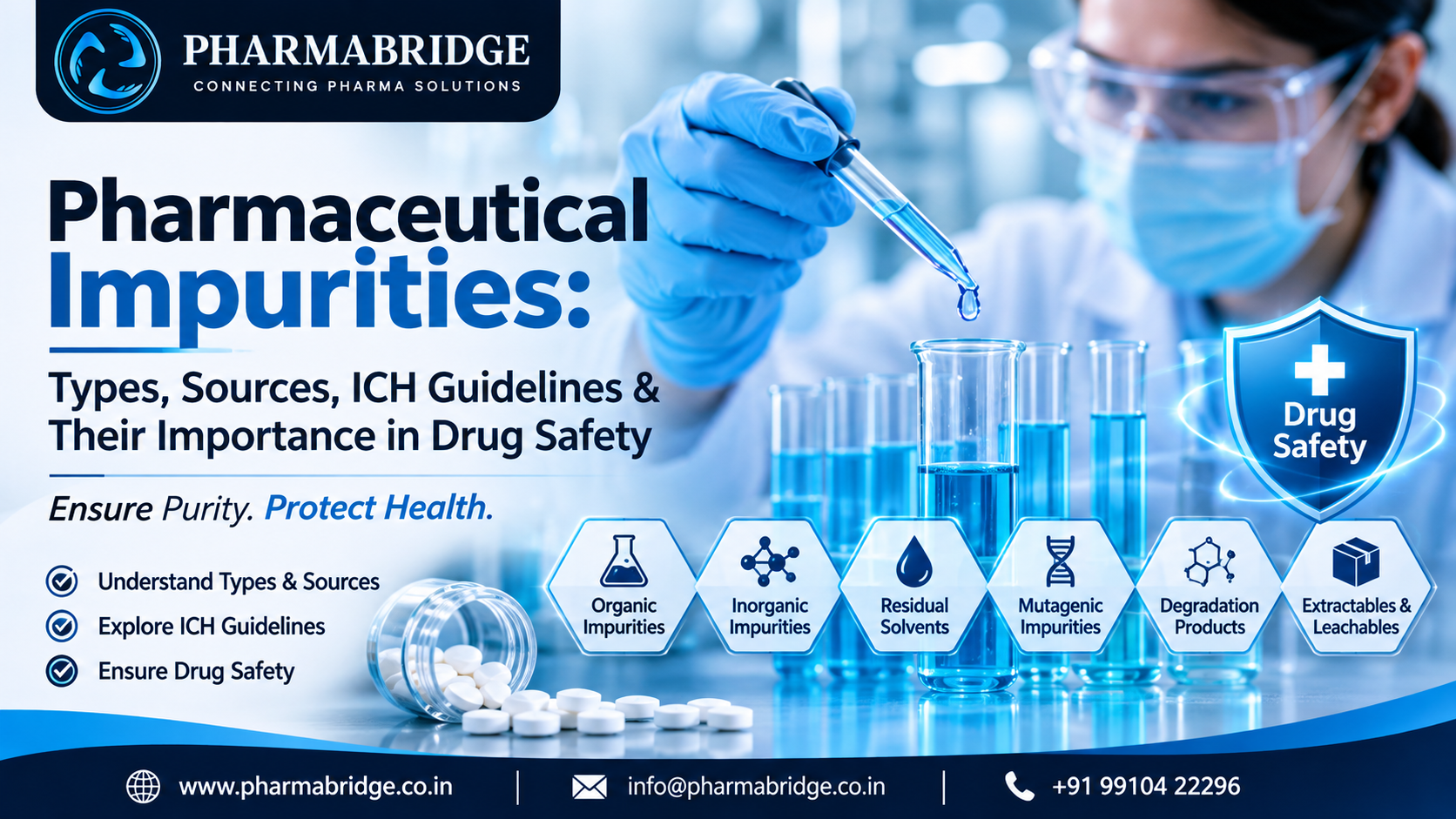
Pharmaceutical Impurities: Types, Sources, ICH Guidelines & Their Importance in Drug Safety
"Pharmaceutical impurities can affect the quality, stability and safety of medicines. This blog explores the major types of impurities, their common sources, analytical testing methods and important ICH guidelines for impurity control. Learn why effective impurity management matters in pharmaceutical manufacturing and how PharmaBridge supports quality-focused sourcing of APIs, intermediates and reference impurities."
The quality and safety of medicines depend on more than just their Active Pharmaceutical Ingredients (APIs). Every pharmaceutical product must meet established standards for identity, purity, strength and quality before reaching the market.
During pharmaceutical manufacturing, chemical synthesis, formulation or storage, unwanted substances may enter a product or develop over time. These substances are known as pharmaceutical impurities.
Although not every impurity presents a health risk, certain impurities may affect product safety, stability, effectiveness or regulatory acceptability. This makes impurity identification, testing and control an essential part of pharmaceutical quality management.
For pharmaceutical manufacturers, procurement teams and research organizations, understanding impurity profiles is equally important when selecting APIs, intermediates and other raw materials.
At PharmaBridge, we recognize the importance of quality-focused pharmaceutical sourcing. From APIs and oncology ingredients to intermediates and reference impurities, reliable product information and appropriate technical documentation play an important role in supporting pharmaceutical procurement decisions.
Let's understand the major types of pharmaceutical impurities, their sources, relevant ICH guidelines and their importance in drug safety.
1. What Are Pharmaceutical Impurities?
Pharmaceutical impurities are unwanted chemical substances that may be present in an Active Pharmaceutical Ingredient or finished drug product.
They can originate during manufacturing, purification, formulation, packaging or storage.
Their presence may result from incomplete chemical reactions, contamination, degradation or the use of certain manufacturing materials.
Depending on their nature and potential risk, pharmaceutical impurities require appropriate identification, analytical evaluation and control.
Some common examples include:
Unreacted starting materials.
Manufacturing intermediates and reaction by-products.
Residual solvents.
Elemental impurities and metal residues.
Degradation products.
Potentially mutagenic impurities.
Understanding their origin and characteristics helps pharmaceutical manufacturers establish suitable quality control procedures.
2. Different Types of Pharmaceutical Impurities
Pharmaceutical impurities can be classified into several categories based on their chemical composition, origin and potential impact.
A. Organic Impurities
Organic impurities are carbon-containing substances that may remain in an API or develop during manufacturing and storage.
They commonly originate from chemical synthesis, processing or degradation.
Examples include:
Starting material residues.
Intermediate compounds.
Reaction by-products.
Reagents and process-related residues.
Degradation products.
Organic impurity profiling helps manufacturers understand the chemical composition of an API and identify substances that require further evaluation.
ICH Q3A(R2) provides guidance on impurities in new drug substances.
B. Inorganic Impurities
Inorganic impurities are non-organic substances that may enter pharmaceutical materials during manufacturing or processing.
They can originate from catalysts, reagents, processing equipment, filter aids and other manufacturing materials.
Common examples include:
Metal residues.
Inorganic salts.
Catalyst residues.
Residues from processing materials.
Certain elemental impurities require specific evaluation because their safety limits depend on factors such as toxicity and route of administration.
ICH Q3D provides guidance for assessing and controlling elemental impurities in drug products.
C. Residual Solvents
Residual solvents are organic volatile chemicals that may remain in pharmaceutical substances after manufacturing or purification.
They are commonly used during chemical reactions, extraction, crystallization and purification processes.
Examples include:
Methanol.
Ethanol.
Acetone.
Toluene.
Dichloromethane.
The presence of residual solvents must be evaluated according to their toxicological characteristics and applicable regulatory limits.
ICH Q3C provides guidance on residual solvents and their acceptable exposure levels in pharmaceutical products.
D. Mutagenic Impurities
Mutagenic impurities are substances that may cause changes in genetic material.
Certain DNA-reactive impurities may present potential carcinogenic risks depending on their nature and exposure.
These impurities require particular attention during pharmaceutical development and manufacturing.
ICH M7(R2) provides recommendations for identifying, assessing and controlling DNA-reactive mutagenic impurities in pharmaceuticals to limit potential carcinogenic risks.
E. Degradation Products
Degradation products develop when pharmaceutical substances undergo chemical changes over time.
These changes may occur due to exposure to:
Heat.
Moisture.
Oxygen.
Light.
Incompatible storage conditions.
Degradation can affect product stability, purity and potentially its performance.
ICH Q3B(R2) provides guidance for the identification, qualification and control of impurities in new drug products.
F. Extractables and Leachables
Extractables and leachables are substances associated with packaging materials, manufacturing equipment and product-contact components.
Extractables are substances that can be released from materials under controlled or exaggerated extraction conditions.
Leachables are substances that migrate into the actual pharmaceutical product under normal or simulated conditions of use.
These substances require appropriate assessment because they may affect product quality and patient safety.
ICH Q3E is being developed to provide a harmonised framework for assessing and controlling extractables and leachables in pharmaceutical products. It is important to note that Q3E remains a draft guideline rather than a finalised Step 4 guideline.
3. Common Sources of Pharmaceutical Impurities
Identifying where impurities originate is an important step in preventing contamination and maintaining pharmaceutical quality.
The following are some common sources:
1. Raw Materials
Poor-quality starting materials or inconsistent raw material specifications may introduce unwanted substances into the manufacturing process.
2. Manufacturing Processes
Incomplete reactions, side reactions and inadequate purification can result in process-related impurities.
3. Reagents and Catalysts
Chemical reagents, catalysts and processing agents may leave residues in the final API if not appropriately controlled.
4. Equipment and Manufacturing Environment
Equipment surfaces, processing components and inadequate cleaning practices may contribute to contamination.
5. Storage and Transportation
Temperature fluctuations, humidity, light exposure and unsuitable packaging can contribute to product degradation.
6. Packaging Materials
Certain substances may migrate from containers, closures or other product-contact materials into pharmaceutical products.
A systematic review of these sources helps manufacturers establish appropriate preventive and monitoring strategies.
4. Important ICH Guidelines for Pharmaceutical Impurities
The International Council for Harmonisation (ICH) develops internationally harmonised technical guidelines to support pharmaceutical quality, safety and regulatory consistency.
Several ICH guidelines are particularly important for impurity management and analytical quality control.
ICH Q3A(R2) – Impurities in New Drug Substances
ICH Q3A(R2) focuses on identifying, reporting, qualifying and controlling impurities in new drug substances.
It addresses impurities that may develop during the manufacturing and storage of APIs. The guideline also provides recommendations for establishing appropriate impurity specifications.
ICH Q3B(R2) – Impurities in New Drug Products
ICH Q3B(R2) focuses on impurities in finished pharmaceutical products.
It provides guidance for identifying and controlling degradation products that may develop during formulation, manufacturing and storage.
This guideline helps manufacturers evaluate the stability and quality of finished drug products.
ICH Q3C – Impurities: Residual Solvents
ICH Q3C addresses residual solvents used or generated during pharmaceutical manufacturing.
It classifies solvents according to their potential health risks and establishes permitted daily exposure recommendations.
The guideline helps manufacturers select suitable solvents and control their residues in pharmaceutical substances and products.
ICH Q3D(R2) – Elemental Impurities
ICH Q3D(R2) focuses on controlling elemental impurities in pharmaceutical drug products.
It establishes permitted daily exposure limits for specified elemental impurities and provides a risk-based approach to their assessment and control.
This is particularly important when evaluating metal residues originating from catalysts, equipment and manufacturing processes.
ICH M7(R2) – DNA-Reactive Mutagenic Impurities
ICH M7(R2) provides guidance for identifying, assessing and controlling DNA-reactive mutagenic impurities that may present potential carcinogenic risks.
It supports appropriate toxicological assessment and scientifically justified control strategies throughout pharmaceutical development and manufacturing.
ICH Q3E – Extractables and Leachables
ICH Q3E addresses the assessment and control of extractables and leachables associated with pharmaceutical packaging and product-contact materials.
The guideline is currently under development and provides a proposed risk-based framework for evaluating these substances.
ICH Q2(R2) – Validation of Analytical Procedures
ICH Q2(R2) provides guidance on validating analytical procedures to demonstrate that they are suitable for their intended purpose.
It is relevant to pharmaceutical impurity testing because analytical methods must demonstrate appropriate performance when identifying or quantifying impurities.
ICH Q14 – Analytical Procedure Development
ICH Q14 focuses on the scientific and systematic development of analytical procedures.
It supports the development of reliable analytical methods through a science-based and risk-based approach.
Together, ICH Q2(R2) and Q14 help pharmaceutical laboratories develop and validate analytical procedures used for impurity testing and quality evaluation.
Why Are These Guidelines Important?
These guidelines help pharmaceutical manufacturers establish scientifically justified impurity specifications, analytical testing strategies and risk-based quality controls.
However, impurity limits are not universal. Applicable thresholds and acceptance criteria depend on factors such as daily dosage, impurity characteristics, toxicological data, product type and relevant regulatory requirements.
Manufacturers must therefore evaluate each impurity according to the applicable guideline and destination market requirements.
5. How Are Pharmaceutical Impurities Detected?
Accurate impurity identification requires suitable analytical techniques.
The choice of testing method depends on the chemical characteristics of the impurity, expected concentration and purpose of the analysis.
Some commonly used analytical techniques include:
HPLC (High-Performance Liquid Chromatography)
HPLC is widely used for separating, identifying and quantifying many organic impurities in pharmaceutical substances.
UPLC (Ultra-Performance Liquid Chromatography)
UPLC provides efficient chromatographic separation and can support detailed impurity profiling.
GC (Gas Chromatography)
GC is commonly used for analysing volatile compounds and residual solvents.
LC-MS (Liquid Chromatography-Mass Spectrometry)
LC-MS helps identify and investigate complex organic impurities through chromatographic separation and mass-based analysis.
GC-MS (Gas Chromatography-Mass Spectrometry)
GC-MS is used for identifying and analysing volatile compounds and selected trace impurities.
ICP-MS (Inductively Coupled Plasma Mass Spectrometry)
ICP-MS is used for detecting and quantifying elemental impurities at low concentrations.
Analytical procedures should be appropriate for their intended purpose and validated according to applicable requirements.
6. Why Is Pharmaceutical Impurity Control Important for Drug Safety?
Impurity control is an essential component of pharmaceutical quality assurance.
Without suitable controls, unwanted substances may create potential risks or compromise product quality.
Here are some key reasons why impurity management matters:
Patient Safety: Identifying and controlling potentially harmful impurities helps reduce unnecessary exposure to unwanted substances.
Product Stability: Monitoring impurities helps identify chemical degradation and evaluate changes during storage.
Product Quality: Consistent impurity profiles support reliable pharmaceutical manufacturing and batch-to-batch consistency.
Regulatory Compliance: Appropriate impurity assessment helps manufacturers meet applicable pharmaceutical quality and regulatory requirements.
Manufacturing Reliability: Effective impurity control supports process understanding, supplier evaluation and consistent production.
Ultimately, impurity management is not simply a laboratory requirement. It is an important part of the entire pharmaceutical quality system.
7. How to Choose a Reliable Pharmaceutical Impurity Supplier?
Selecting a reliable supplier is an important step for pharmaceutical manufacturers, analytical laboratories and research organizations.
Reference impurities are particularly useful for analytical identification, qualification and quantification when suitable characterized reference materials are required.
Before selecting a pharmaceutical impurity supplier, consider the following factors:
1. Product Identity and Purity
Verify the chemical identity, purity information, specifications and intended application of the reference impurity.
2. Certificate of Analysis (CoA)
Review batch-specific analytical information and ensure that the documentation matches the supplied material.
3. Technical Documentation
Check the availability of relevant analytical data, safety information and characterization documents.
4. Traceability
Understand the manufacturer's identity, source of material and batch traceability.
5. Quality and Compliance
Evaluate the supplier's quality documentation, manufacturer qualification and applicable regulatory requirements.
6. Technical Support
Choose a sourcing partner that can assist with product specifications, documentation requirements and procurement coordination.
A reliable sourcing partner can help simplify product evaluation and make the procurement process more transparent.
8. How PharmaBridge Supports Pharmaceutical Sourcing
Finding the right pharmaceutical material requires more than comparing availability and prices. Product quality, technical specifications, manufacturer reliability and regulatory documentation are equally important.
PharmaBridge works as a pharmaceutical sourcing partner, connecting pharmaceutical manufacturers, procurement teams and global buyers with suitable manufacturers and product sourcing solutions.
Our pharmaceutical portfolio includes:
Active Pharmaceutical Ingredients (APIs).
Oncology APIs and intermediates.
Standardized Herbal Extracts.
Anticancer APIs.
Pharmaceutical Reference Impurities.
PharmaBridge also supports buyers with technical and regulatory documentation, including Certificates of Analysis (CoA), Drug Master File (DMF) documentation and other relevant quality documents, depending on product and sourcing requirements.
Our objective is to make pharmaceutical procurement more straightforward through transparent communication, quality-focused sourcing and dependable coordination.
Whether you require pharmaceutical APIs, specialized intermediates or reference impurities for analytical applications, PharmaBridge aims to support your sourcing requirements with appropriate technical assistance.
Explore PharmaBridge: https://pharmabridge.co.in/
9. Conclusion
Pharmaceutical impurities are an important consideration throughout drug development, manufacturing and storage. Understanding their types, sources and potential risks helps pharmaceutical organizations establish appropriate quality control measures.
From organic impurities and residual solvents to elemental and mutagenic impurities, each category requires suitable identification, evaluation and control based on its characteristics and applicable regulatory guidance.
ICH guidelines provide a structured framework for managing these impurities, while appropriate analytical techniques help ensure reliable evaluation.
Alongside testing and regulatory compliance, choosing dependable pharmaceutical sourcing partners is equally important.
PharmaBridge remains focused on connecting pharmaceutical buyers with suitable APIs, intermediates, oncology ingredients, standardized herbal extracts and reference impurities, supported by technical documentation and sourcing assistance.
Because better pharmaceutical sourcing begins with better quality decisions.
Frequently Asked Questions (FAQs)
Q1. What are pharmaceutical impurities?
Pharmaceutical impurities are unwanted chemical substances present in APIs or finished drug products. They may originate during manufacturing, processing, storage or degradation.
Q2. What are the main types of pharmaceutical impurities?
The major categories include organic impurities, inorganic impurities, residual solvents, elemental impurities, mutagenic impurities, degradation products and extractables and leachables.
Q3. Which ICH guideline covers pharmaceutical impurities?
Several guidelines address different impurity categories. ICH Q3A covers impurities in new drug substances, Q3B covers drug products, Q3C covers residual solvents, Q3D covers elemental impurities and M7 addresses DNA-reactive mutagenic impurities.
Q4. How are pharmaceutical impurities tested?
Common techniques include HPLC, UPLC, GC, LC-MS, GC-MS and ICP-MS. The appropriate method depends on the impurity type and analytical requirements.
Q5. Why are reference impurities important?
Reference impurities are characterized materials that help analytical laboratories identify and quantify impurities during pharmaceutical testing and quality evaluation.
Q6. How can I find a pharmaceutical reference impurity supplier?
Look for suppliers that provide reliable product identification, batch-specific CoA, suitable analytical documentation, traceability and technical support. PharmaBridge supports pharmaceutical sourcing requirements for APIs, intermediates and reference impurities.
Connect With PharmaBridge
Website: https://pharmabridge.co.in/
PharmaBridge – Connecting Pharma Solutions.
Have Formulation or Sourcing Requirements?
Inquire directly regarding batch pricing, regulatory dossiers (DMF, CoA, VQ), and evaluation samples.